The Walk That Began a Revolution
Long before she became a name repeated in business circles, classrooms, and discussions about women entrepreneurs in India, Jaswantiben Jamnadas Popat was simply a young woman walking endlessly through the crowded lanes of Mumbai. Every morning, she tightened her saree, stepped out of her modest home, and began walking. She walked because she had no choice; survival demanded it. Her family depended on her, and her only weapon against hardship was her determination to keep moving.
Her daily walk stretched nearly twenty kilometres, each step filled with uncertainty. No promising job opportunities were waiting for her, especially not for a woman without formal education. Yet she walked, because hope was the only thing she could afford. What she didn’t know then was that this long, painful walk would eventually become the opening chapter of one of the most celebrated journeys in Indian startups, a journey that would change not only her life but also the lives of thousands of women across the country.
Her struggles, her resilience, and her persistence would soon be remembered as one of her stories that continues to inspire generations of women who dare to dream.
A Chance Encounter on a Rooftop
One afternoon, during one of her exhausting search-for-work walks, Jaswantiben heard laughter floating down from a nearby chawl’s terrace. Drawn by the sound of joy she hadn’t felt in a long time, she climbed the narrow staircase to the rooftop. There she saw a small group of women sitting together under the sun, shaping dough into small circles, flattening them gently, and laying them on clean cloths to dry.
They weren’t businesswomen. They were homemakers trying to earn a few rupees to support their families. They had no machines, no financial backing, and certainly no grand entrepreneurial vision. What they did have was each other. They had a shared desire to survive, to support their children, and to work in dignity.
When they saw exhaustion on Jaswantiben’s face, they invited her to sit with them. They offered her water, a smile, and something she desperately needed: belonging. That moment, simple and warm, became the turning point in her life.
Sometimes revolutions don’t begin with grand speeches. Sometimes they begin on a quiet rooftop, with women who refuse to give up.
How Did Jaswantiben Popat Start Her Business?
When people ask, “How did Jaswantiben Popat start her business?”, the answer surprises them. There were no investors. No strategies. No startup mentors. No plans written on laptops or whiteboards. The foundation of her business was built on empathy and necessity.
The women realised that papad-making was a skill they all shared. But raw materials required money, something none of them had. Together, they gathered whatever they could and managed to collect eighty rupees. Today, eighty rupees might buy a packet of biscuits, but back then, it was a fortune scraped together through courage and trust.
With this small amount, they bought ingredients and started making papads on the rooftop. They washed lentils, ground them manually, kneaded dough with their hands, and rolled each papad with care. When the sun rose high, the papads would lie drying in neat rows. In the evening, they wrapped the finished batches and walked through the neighbourhood to sell them to shopkeepers.
There was no marketing, no branding, no corporate structure – just women walking door to door, with papads in their hands and hope in their hearts. Slowly, their papads gained popularity because they were consistent, tasty, and handmade with sincerity. Shops began asking for more, and the group realised they had unknowingly built a business.
What began as a survival attempt soon evolved into the foundation of one of India’s largest women-led cooperatives.
A Cooperative Built on Sisterhood
As the papads gained popularity, something extraordinary happened. Women from nearby localities began approaching the group, asking if they too could join. These women weren’t looking for charity; they wanted opportunity. They wanted the dignity of earning. They wanted independence.
The group welcomed every woman who came to them. There were no restrictions, no judgements, and no conditions. Each woman was considered equal. Each woman had a voice. Decisions were made collectively. Profits were shared. The cooperative became a safe haven for women who had been told all their lives that they were meant only for household work.
What began with seven women grew into hundreds. Those hundreds turned into thousands. And eventually, more than forty-five thousand women across India became part of the movement. They were proudly called “Lakhpati Bens”, sisters of prosperity, because they earned with dignity and respect.
This cooperative model became a case study for economists, social workers, and researchers who wanted to understand how a simple rooftop initiative became a nationwide phenomenon in the world of Indian startups.
From a Rooftop to Every Indian Kitchen
The success of their papads was never driven by aggressive advertising or corporate strategies. It grew because every papad carried the warmth of a woman’s hands and the strength of her determination. Families loved the taste. Restaurants loved the consistency. Shops trusted the quality.
Soon, the papads reached markets across cities, states, and eventually across borders. The name Lijjat Papad became synonymous with trust. Every Indian kitchen had a packet tucked inside a cabinet. The cooperative expanded into new products like spices, detergents, and flour, but the heart of the organisation remained the papad that started it all.
Despite growing into a ₹100 crore organisation, the cooperative never abandoned its original values. Every decision remained collective. Every member remained an equal partner. This was not just a business anymore—it was a living symbol of women’s empowerment.

The Awards That Recognised a Lifetime of Courage
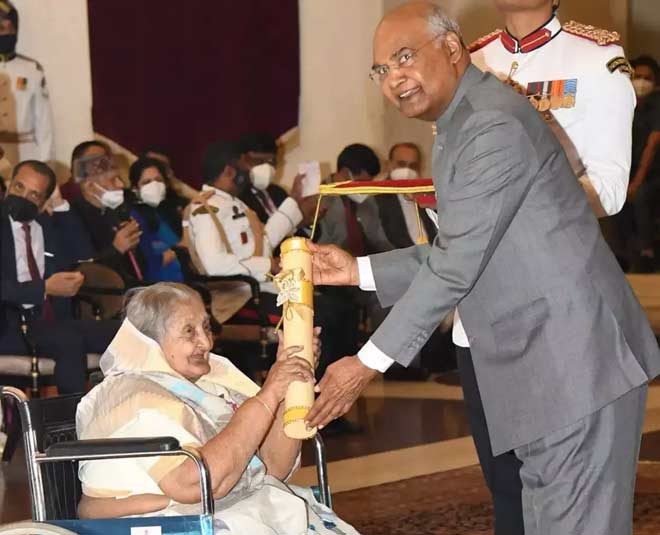
When people ask, “What are the awards won by Jaswantiben Popat?”, the most iconic one stands out clearly. In 2021, the Government of India honoured Jaswantiben Jamnadas Popat with the prestigious Padma Shri, one of the highest civilian awards of the nation. When she received the award in her simple saree, she represented not just herself but the strength of thousands of women whose lives had changed through Lijjat.
Her Padma Shri wasn’t just a recognition of success. It was a celebration of her courage, her resilience, and her extraordinary contribution to uplifting women in India. It symbolised decades of silent but powerful effort by women who built a ₹100 crore empire without losing their values or humility.
Why Her Story Still Inspires Generations
In a world obsessed with unicorns, valuations, and high-profile funding rounds, the story of Jaswantiben reminds us where true entrepreneurship begins. It begins in the heart, not in a presentation. It begins in struggle, not luxury. It begins with a purpose, not profit.
Her journey is told again and again in classrooms and articles about women entrepreneurs in India, because she embodies the kind of strength that changes societies. She proved that education is not the only path to success. She proved that financial limitations cannot stop a determined woman. She proved that even the smallest business, when built on honesty and unity, can grow into a legend.
A Legacy Woven Into Every Papad
Today, long after she rolled her first papad, her legacy continues in every batch produced by the cooperative. Thousands of women across India continue to join the movement, shaping dough just as the original seven women once did. Each packet of Lijjat Papad carries the story of her resilience, leadership, and unshakeable faith in collective strength.
Her footsteps may have slowed, but her impact walks into every Indian home. Her story shines in every new startup founded by a woman, in every home business that begins with nothing, and in every dream that rises out of struggle.
From walking twenty kilometres a day in desperation to inspiring millions as a Padma Shri awardee, her journey is nothing short of extraordinary. It is a reminder that greatness is born not from privilege, but from perseverance.