
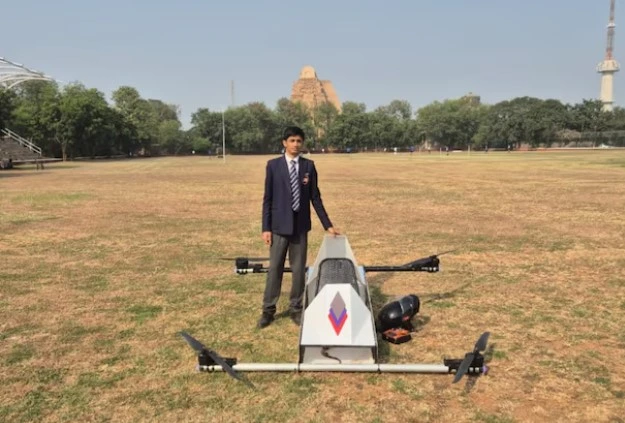
A New Chapter in Indian Startup Stories Begins in a School Workshop
Every generation has its prodigies, children who defy logic, challenge norms, and attempt the impossible before the world even realises what they are capable of. But once in a while, someone comes along whose story feels almost cinematic, as if crafted for the screen yet rooted in very real grit. The story of Medhansh Trivedi, the 17-year-old who built a human-carrying drone from scratch, belongs to this rare category of Indian startup stories that don’t just inspire they redefine what ambition looks like.
Long before journalists and ministers applauded him, before the news channels described him as India’s youngest aerial mobility innovator, Medhansh was just another bright student wandering through the halls and workshops of The Scindia School, Gwalior. But unlike most students, he was not content with solving textbook problems. His mind was wired differently, always observing, always questioning, always pushing the boundaries of what young India could build.
It was in those quiet moments between classes, while tinkering with tools or watching videos of global drone technology, that a spark ignited. That spark would eventually give India one of its most remarkable startup ki story moments, one that blends youthful imagination, technical brilliance, and the courage to dream beyond limitations.
A Seed of Curiosity That Turned Into an Obsession
While many teenagers scroll endlessly through social media, Medhansh spent his hours absorbed in the world of engineering marvels. China’s rapid drone revolution fascinated him to the point where it no longer felt like distant news. It felt like a challenge an invitation to innovate. When he saw videos of human-carrying drones emerging from Chinese research labs, he wasn’t intimidated. Instead, something in him whispered, “Why not here? Why not me?”
This is where the foundation of the Medhansh Trivedi drone story was laid, not in a laboratory or a corporate office, but in the mind of a teenager who refused to accept that innovation had an age limit.
With no blueprint for success and only a stubborn passion for engineering pushing him forward, Medhansh began planning something that even trained aerospace engineers might hesitate to attempt: a single-seater aerial vehicle capable of lifting and transporting a human safely.
Most people dream. He built.
The Birth of MLDT 01: A Drone Designed to Carry Dreams
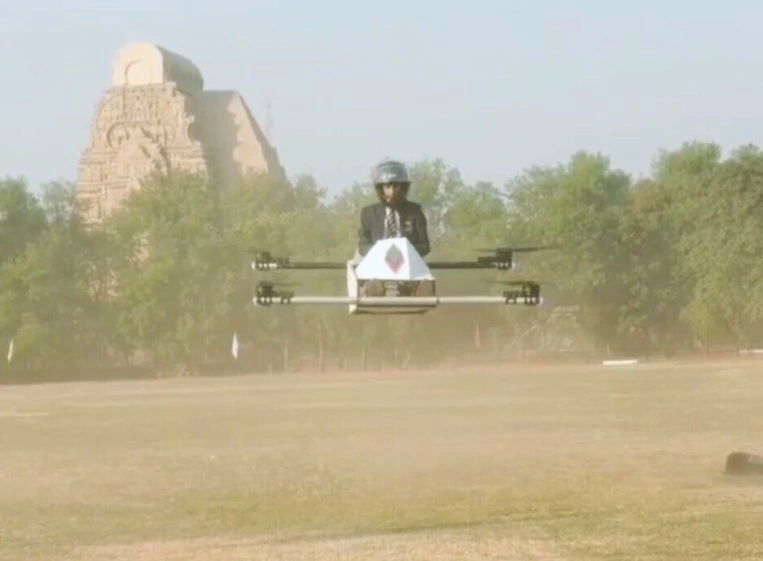
Three months. That’s all it took for Medhansh to design, construct, assemble, test, refine, and finally fly a drone capable of lifting to 80 kilograms. For most engineers, building even a basic drone requires months of research and development. However, this boy, still in Class 12, built a 45-horsepower, human-carrying drone that could fly at a cruising speed of 60 km/h.
The drone wasn’t just an experiment; it was a demonstration of India’s emerging engineering talent. A showcase of what young Indian entrepreneurs can achieve when given the right environment and encouragement.
MLDT 01 was not built with millions in funding or a high-tech lab. It cost just ₹3.5 lakh, a figure that shocks anyone with even basic knowledge of aerospace engineering. Its body, motors, and control systems were assembled with careful precision, and its four-motor setup, similar to that of agricultural drones, formed the backbone of its power.
The drone stayed airborne for six minutes and rose to a height of 10 metres, not due to technical limitations but due to safety protocols. Everyone who witnessed its maiden flight understood that they were watching the future unfold an early blueprint of India’s own aerial mobility revolution led by youth.
The Teacher Who Saw Potential Before the World Did
Every great Startup ki Story has a mentor in the background, someone who becomes the guiding force behind a young mind. For Medhansh, that mentor was Manoj Mishra, a teacher who nurtured his curiosity long before he imagined building a flying machine. Mishra wasn’t just a teacher; he was an architect of confidence.
Year after year, he noticed how Medhansh gravitated toward engineering experiments, science project models, and any machinery he could get his hands on. Whether it was a school-level prototype or a new invention trending online, the young student’s enthusiasm was unmistakable.
When Medhansh came to him with the idea of designing a human-carrying drone, Mishra did not dismiss it as teenage fantasy. Instead, he encouraged him, guided him, and made sure that the school workshop transformed into a mini research lab where ideas could fly, sometimes literally.
Such stories emphasise why India needs mentors who do more than teach. They inspire.
Recognition from the Highest Corners of the Country
Innovation rarely goes unnoticed and in this case, the country’s top leaders became admirers of this young inventor almost instantly.
When the Minister of Civil Aviation, Ram Mohan Raju Kinjarapu, met Medhansh, he saw not just a school student but a symbol of India’s technological future. He listened to the boy’s dreams of building air taxis and transport drones with genuine excitement, calling his vision “inspiring” and “a testament to India’s bright future in innovation.”
Soon after, the former Chief of ISRO, S. Somanath, also praised Medhansh’s invention. Coming from a man who has guided India’s space ambitions, this recognition felt monumental a validation that MLDT 01 wasn’t just a viral project but a serious step forward for India’s aerial innovation ecosystem.
Another voice that joined this chorus was that of business tycoon Anand Mahindra, known for spotting exceptional talent. His message was clear: innovation is not only about resources or technology but about the passion to execute ideas fearlessly. Medhansh had exactly that.
This young inventor had earned the respect of leaders, scientists, and business icons—an achievement that even seasoned Indian entrepreneurs would consider remarkable.
The Scindia School Legacy and the Culture of Innovation
The Scindia School, Gwalior, is an institution known for shaping leaders. But what makes its environment so transformative is not just academic rigour; it’s the culture of innovation. For decades, its alumni have contributed to engineering, government, business, and policymaking. The school encourages students to think beyond textbooks, experiment fearlessly, and most importantly, believe that ideas can shape nations.
When the Union Minister Jyotiraditya Scindia, the school’s patron and an alumnus himself, met Medhansh, it wasn’t merely a congratulatory gesture. It was an acknowledgement of the school’s legacy and a promise of support. He urged Medhansh to pursue global opportunities, apply to the world’s top institutions, and nurture his innovation into a transformative career path.
Scindia’s message was simple: MLDT 01 was just the beginning.
A Child Who Dreamed of Machines Before He Dreamed of College
People often assume that teenage success is sudden. But in reality, brilliance builds over years. Medhansh’s fascination with machines can be traced back to Class 7, where he would dismantle toys, examine motors, and endlessly explore videos about inventions. His curiosity wasn’t random; it was a calling.
His teacher remembers how he was always the student eager to build models, solve real-world problems, and understand how things worked rather than memorising theories. When he saw videos of human-carrying drones in China, something clicked. It wasn’t envy—but inspiration. If another country could do it, why couldn’t India?
This question stayed with him until he turned it into an invention.
India and China: A Race to Own the Sky
The Medhansh Trivedi drone didn’t emerge in isolation. It came at a time when global drone technology was undergoing a revolution. China is still one of the largest drone manufacturers in the world, with companies like DJI influencing industries from farming to filmmaking. Chinese cities are already experimenting with aerial taxis, creating an early blueprint for flying vehicles.
India, meanwhile, is on the cusp of a breakthrough. Policy changes, the Production Linked Incentive (PLI) scheme, and an increasing wave of young innovators have pushed India into the global drone race. But what truly sets India apart is its talent pool of young minds who are building advanced technology with fewer resources but greater passion.
Medhansh represents this rise. His drone is not a product of high investment but of high imagination. It signals that India is ready to compete and even lead in the world of aerial mobility.
The Road Ahead: Air Taxis and Aerial Dreams
Every visionary sees beyond the prototype, and so does Medhansh. MLDT 01 is only the first chapter of his story. He dreams of building air taxis, creating drones for agricultural tasks, developing cargo drones for heavy transport, and ultimately founding a company that makes aerial mobility accessible to everyone.
He imagines a future where drones carry people across cities, where travel time drops significantly, and where India leads the world in electric aviation. For him, the drone he built isn’t a final product it’s a stepping stone.
Such thinking is what turns inventors into entrepreneurs.
Why This Teenage Inventor Represents the Future of Indian Entrepreneurship
Many Indian entrepreneurs begin their journey after college or after years in the corporate world. But the new generation of students, like Medhansh, is changing that timeline. They’re starting young, dreaming big, and proving that innovation has no age limit.
His journey is one of the most inspiring startup stories of modern India. It reflects how passion, mentorship, school support, and national recognition can align to create something extraordinary. It also shows that the next era of Indian startup stories will not just come from metro cities or venture-funded founders but from school classrooms where imagination meets courage.
The startup ki story of this young inventor has already begun, and India is watching.
Conclusion: A Sky Full of Possibilities
In every era, someone pushes the boundaries and shows the world what the future looks like. For India, that someone right now is a 17-year-old boy who built a human-carrying drone with his own hands.
The journey of Medhansh Trivedi is a reminder that technology is not just about machines. It is about imagination. It is about asking “what if” when everyone else is saying “impossible”. It is about believing that a school student can redefine the future of aviation.
His drone, MLDT 01, is more than an invention. It is a message to the world that the next wave of global innovation may rise from the classrooms of India.
And this young boy, with his soaring dreams, has shown an entire generation how to take flight literally and metaphorically.
This is not just his story.
This is India’s story.
A story that has only just begun to take off.


One thought on “The Future Takes Flight: The Extraordinary Startup Story of 17-Year-Old Innovator Medhansh Trivedi”